AI Security for Government and Critical Infrastructure
AI security for government and critical infrastructure means adversarial testing and runtime protection of AI systems deployed in public-sector and regulated environments — with Canadian data residency, full audit logging, and alignment to NIST AI RMF, CCCS, and Canada’s Bill C-8 cybersecurity requirements.
Government bodies and regulated operators are deploying AI faster than existing controls can govern it. SecuritAI delivers the adversarial testing and real-time firewall built for that gap.
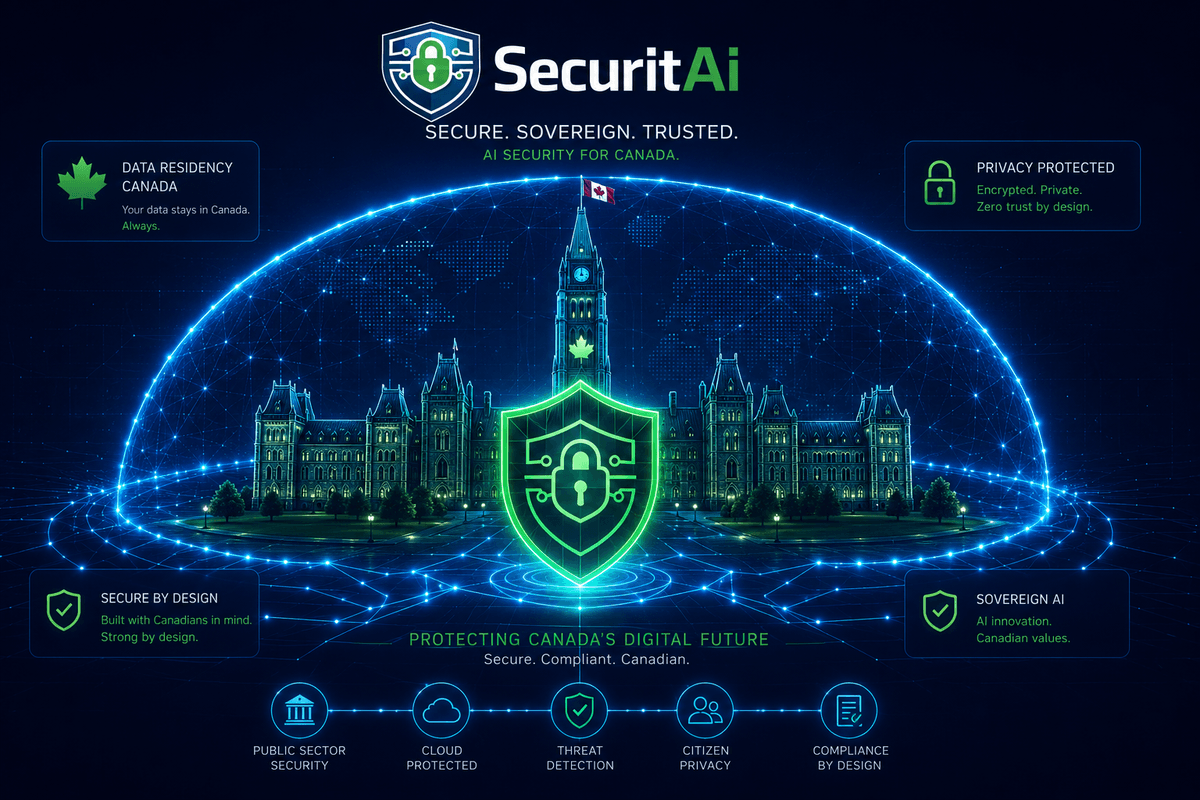
When government deploys AI, the bar is higher.
A chatbot that leaks a citizen’s data, an AI agent manipulated into an unauthorized action, or a model that can be jailbroken — in the public sector and critical infrastructure these are not bugs, they are incidents with legal, privacy, national-security, and public-trust consequences.
Bill C-8 and AI in Critical Infrastructure
Canada’s critical infrastructure cybersecurity legislation establishes binding duties for designated operators in energy, telecommunications, transportation, and finance. As AI systems become operational in these sectors, those duties extend to the AI layer — and most operators have no controls there yet.
Designated operators must establish cybersecurity programs, report incidents, and protect critical systems including any AI that touches operations, data, or public services.
Traditional cybersecurity programs do not cover prompt injection, jailbreaks, or AI-specific attack vectors. Regulators are beginning to ask: what did you test your AI against?
Documented adversarial testing evidence, runtime monitoring, and audit logs — the records a C-8 cybersecurity program needs to demonstrate AI security due diligence.
For full compliance automation and C-8 documentation, see SecuritComply’s Bill C-8 compliance platform.
Critical sectors we serve
Any sector where an AI failure has consequences beyond a single organization.
AI chatbots, document processing, and citizen-facing services.
AI in grid management, predictive maintenance, and operational control.
AI-powered network monitoring, fraud detection, and customer systems.
AI in logistics, traffic management, and public transit operations.
AI diagnostics, patient data systems, and clinical decision tools.
CPCSC-aligned testing for federal and defence contractors.
The controls your mandate requires — applied to AI
Canadian data residency; on-prem or private-VPC so AI traffic and logs never leave your boundary.
PII detection and redaction; built-in PIPEDA reporting.
Full, exportable logs of every prompt and response; attack replay for incident review.
Role-based access, tenant isolation, geo-blocking, and time-window policies.
Continuous adversarial red-teaming and runtime monitoring aligned to Bill C-8 critical-systems cybersecurity duties.
Documented testing, guardrails, and monitoring evidence aligned to recognized AI risk frameworks.
For federal and defence supply-chain mandates, our compliance platform SecuritComply helps you get CPCSC-ready.
Red-teaming findings and firewall audit logs feed directly into ISO 27001 and SOC 2 evidence packages.
SecuritAI states alignment and capability, not certifications we do not yet hold. For full compliance automation across PIPEDA, CPCSC, SOC 2, and ISO 27001, see SecuritComply.
Deploy it where your data has to stay
Private VPC
Runs inside your own cloud tenant.
On-premises
Fully air-gapped option for sensitive environments.
Canadian-hosted
We run it, in Canada, with data residency.
Questions about AI security for government and critical infrastructure
What does Bill C-8 mean for AI systems in critical infrastructure?
Bill C-8 requires designated operators in critical infrastructure sectors to implement cybersecurity programs and protect their systems from attack. As AI becomes operational in energy, telecom, and government, those programs must extend to cover AI-specific threats like prompt injection and adversarial manipulation. SecuritAI provides the testing evidence and runtime controls that demonstrate due diligence under a C-8 cybersecurity program.
What is AI red teaming for government?
AI red teaming for government is a structured adversarial testing process that simulates real attacks against an AI system — chatbots, document processors, or AI agents — before they are deployed or audited. It produces a documented findings report that can serve as evidence of security due diligence for PIPEDA, CCCS, NIST AI RMF, and Bill C-8 compliance programs.
Can SecuritAI run on-premises in a classified or air-gapped environment?
Yes. SecuritAI supports fully on-premises deployment with no external data egress. This is available for federal, defence, and regulated environments where data cannot leave the boundary. Contact us to discuss air-gapped deployment options.
How does SecuritAI align with CCCS and NIST AI RMF?
SecuritAI’s adversarial testing covers the attack categories in the OWASP LLM Top 10 and maps to the Govern, Map, Measure, and Manage functions of the NIST AI RMF. The firewall provides the runtime monitoring component. We produce exportable logs and findings reports designed to serve as evidence in a structured AI risk management program.
Does SecuritAI work with Canadian federal procurement requirements?
SecuritAI Technologies Ltd. is a Canadian company based in Toronto. Our platform runs with Canadian data residency and is designed to support federal and provincial procurement requirements including data sovereignty and audit logging. For CPCSC and defence supply-chain readiness, see SecuritComply.
Let’s secure your AI before it’s audited — or attacked.
Built by SecuritAI Technologies Ltd., a Canadian cybersecurity company serving government and critical infrastructure across Canada.